Education Loan Without Collateral in India: Eligibility, Rates & Best Banks (2026)
 Abhinandan Kumar
Education Loan Without Collateral in India: Eligibility, Interest Rates & Best Banks for 2026
Key Takeaways
Understanding collateral-free education loans can unlock higher education opportunities without risking family assets, making quality education accessible to students from diverse financial backgrounds.
• Students can secure education loans up to ₹7.5 lakh without collateral under government schemes, with premier institutes offering up to ₹40 lakh based on merit.
• Public sector banks offer the most competitive rates (8.10%-10.75%), while private banks (9.50%-13.50%) and NBFCs (11%-16%) provide higher loan limits.
• Co-applicant creditworthiness and CIBIL scores above 750 significantly impact approval chances and interest rates offered by lenders.
• Moratorium periods cover entire course duration plus 6-12 months, with Section 80E providing unlimited tax deductions on interest payments for eight years.
• Academic performance, institution reputation, and chosen field directly influence loan approval, with STEM courses receiving favorable consideration from most lenders.
The key to securing the best education loan lies in comparing multiple lenders and understanding how your academic profile aligns with each institution’s lending criteria. With proper planning and documentation, collateral-free education loans can bridge the gap between educational aspirations and financial reality.

An education loan without collateral might sound too good to be true, but it’s a reality for thousands of students across India. Bank credit for education has crossed ₹1 lakh crore in recent years, and a significant portion of this comes from unsecured loans. For instance, loans up to ₹7.5 lakh typically don’t require collateral under standard banking guidelines.
With this in mind, understanding collateral free education loan options becomes crucial for students planning higher studies. Education loan interest rates currently range from 8.10% to 16% per annum, varying across lenders and loan structures. In this guide, we’ll walk you through eligibility criteria, compare the best banks offering non collateral education loans in 2026, and help you navigate the application process effectively.
What is Education Loan Without Collateral

Image Source: Education Loans for Study Abroad
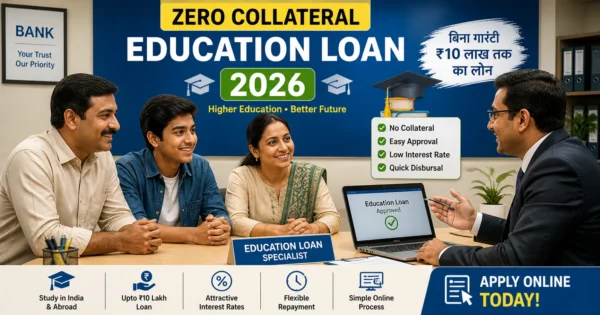
Education loan without collateral is financing that students can access without pledging property, fixed deposits, or other assets as security. In effect, the approval depends on academic merit, admission to recognized institutions, and the co-applicant’s financial standing rather than asset ownership.
This unsecured lending option has opened doors for students from diverse financial backgrounds who lack substantial property holdings. The government supports this through the Credit Guarantee Fund Scheme for Education Loans (CGFSEL), which provides a guarantee for loans up to ₹7.5 lakh without requiring collateral or third-party guarantors.
Key features of collateral free education loan
Several characteristics distinguish non collateral education loans from traditional financing. For one thing, students don’t need to pledge assets, which means families can pursue higher education without risking their property. The processing happens faster since lenders skip collateral assessment and property verification.
You’ll find flexible repayment options with moratoriums that extend until course completion plus 6-12 months. Some lenders even offer loans before admission, ensuring financial security early in the application process. Many cases include 100% financing for higher education, eliminating the need for additional funding sources.
Difference between secured and unsecured student loans
The distinction between these loan types affects your borrowing experience significantly. Secured loans require asset pledges like property or fixed deposits, while unsecured loans operate without such requirements. Interest rates on collateral-free loans typically range from 11% to 15%, compared to 9% to 11% for secured options.
Approval processes differ markedly. Secured loans involve extensive collateral evaluation, whereas unsecured loans prioritize academic records, institution reputation, and co-applicant creditworthiness. Repayment tenure also varies, with secured loans extending up to 15 years and unsecured loans typically capped at 10 years.
Loan limits for studies in India vs abroad
Public sector banks offer up to ₹7.5 lakh without collateral under CGFSEL. However, premier institutes like IITs and IIMs can access up to ₹40 lakh from public banks without pledging assets. Private banks and NBFCs push these limits higher, with some providing up to ₹1.25 crore for abroad studies based on academic profile and co-applicant income. ICICI Bank currently leads with collateral-free limits reaching ₹3 crore.
Eligibility Criteria and Documents Required

Image Source: Education Loans for Study Abroad
Getting approved for an education loan without collateral hinges on meeting specific student and co-applicant criteria that lenders evaluate carefully.
Student eligibility requirements
Both you and your co-applicant must be Indian citizens to qualify for non collateral education loans from domestic lenders. Age requirements typically fall between 16 and 35 years, though this varies by institution. Academic performance matters significantly, with most government banks preferring students who have scored above 60% in their previous academics.
You need confirmed admission to a recognized institution on the lender’s approved list. The university or college reputation directly impacts approval chances, with STEM courses and premier institutions receiving favorable consideration. In essence, your future earning potential based on the chosen field influences lending decisions.
Co-applicant requirements and income proof
A co-applicant with stable income becomes mandatory for unsecured student loans. Parents remain the preferred choice, though siblings, spouses, or legal guardians can qualify. The co-applicant must have a minimum annual income above ₹3 lakhs and a CIBIL score of 700 or above. Age restrictions apply here too, with co-applicants required to be below 60 years.
For salaried co-applicants, you’ll need to submit salary slips from the last 6-8 months along with Form 16 and ITR documents. Self-employed co-applicants must provide GST registration proof, partnership deed or MOA/AOA, Certificate of Incorporation, and financial statements for the last six months.
Academic and admission documents needed
Student documentation includes KYC documents like Aadhaar, PAN, and passport, alongside academic records from 10th, 12th, and graduation. Entrance exam scores and the official admission letter with fee details form crucial components. Recent passport-size photographs of both applicant and co-applicant are standard requirements[81].
Additional documents for abroad education
International education requires a valid passport and visa once issued[103]. Language proficiency scores from IELTS or TOEFL, along with standardized test results like GRE or GMAT, become necessary[92]. Bank statements for the last 6 months help demonstrate financial stability.
Best Banks for Education Loan Without Collateral in 2026

Image Source: Beincareer
Choosing the right lender determines both your loan approval chances and long-term repayment burden. We compare public banks, private lenders, and NBFCs to help you identify the best fit.
Public sector banks (SBI, Bank of Baroda, PNB, Canara Bank)
State Bank of India offers education loan without collateral up to ₹7.5 lakh under standard schemes, with interest rates starting at 8.15%. Under the Global Ed-Vantage scheme, SBI extends collateral-free loans up to ₹50 lakhs for students admitted to premier universities abroad. Bank of Baroda provides similar limits, with rates ranging from 8.40% to 10.50%. Canara Bank’s Vidya Turant scheme offers unsecured loans up to ₹50 lakhs for ISB students at rates starting from 6.85%. Punjab National Bank maintains the standard ₹7.5 lakh collateral-free limit with rates beginning at 8.50%.
Private banks (HDFC, ICICI, Axis Bank)
HDFC Bank provides collateral-free financing starting at 9.50% for amounts up to ₹7.5 lakh. ICICI Bank leads private lenders with unsecured limits reaching ₹1 crore, though rates range from 10.25% to 13.50%. For postgraduate courses, ICICI offers up to ₹40 lakhs without collateral. Axis Bank sanctions up to ₹75 lakhs for select overseas programs at 10.50% onwards.
NBFCs and specialized lenders (Avanse, Auxilo, InCred)
Avanse Financial Services extends unsecured loans up to ₹1.25 crore for abroad studies, with interest rates between 10.25% and 13.50%. Auxilo offers up to ₹65 lakhs without collateral at 11.50% onwards. InCred provides up to ₹80 lakhs with rates from 11.65% to 13.5%. These NBFCs evaluate future earning potential rather than just current assets, making approval faster for students heading to top-ranked universities.
Education loan interest rates comparison
Public sector banks deliver the most competitive student loan interest rates, typically between 8.10% and 10.75%. Private banks price loans slightly higher at 9.50% to 13.50%. NBFCs operate at the upper end, charging 11% to 16% due to unsecured offerings and higher risk tolerance. Female students receive a 0.50% concession from SBI.
Maximum loan amounts without collateral
Public banks provide up to ₹7.5 lakh without collateral under standard schemes. For premier institutes like IITs and IIMs, this extends to ₹40 lakh depending on the institution. Private banks and NBFCs push limits higher, with some offering up to ₹1.25 crore for abroad studies based on profile strength. Comparing education loan rates across these categories helps identify the most cost-effective option for your specific university and course.
How to Apply and Important Factors to Consider

Image Source: Alamy
Step-by-step application process
Applying for an education loan without collateral starts with checking your eligibility online through a short form on the lender’s website. Once you confirm your chosen university and program are supported, complete the full application with details about your studies, background, and funding needs. Submit documents including passport, admission letter, academic records, and co-applicant income proof. After your information is reviewed, you receive a loan offer outlining your terms. Your school then confirms enrollment and funding details before disbursement. The entire process takes roughly 30 minutes to apply, with approval typically within a week.
Factors affecting loan approval
Lenders assess your future earning potential based on your academic performance and chosen field. Your co-applicant’s creditworthiness plays an equally vital role. A CIBIL score between 750-900 significantly improves approval chances and secures the best rates. Scores below 550 often lead to rejection or require additional co-applicants. The reputation of your educational institution matters considerably, with premier universities receiving favorable consideration.
Interest rate determinants
Education loan interest rates have two components: base rate and spread rate. The base rate is predetermined by financial institutions and varies by lender. Avanse, for instance, maintains a base rate of 14.55%. The spread rate floats based on market changes and your overall credit profile. This variable component can increase or decrease during your loan tenure. Interest rates typically range from 9% to 14% per annum depending on creditworthiness and loan type. Higher credit scores translate to lower rates, potentially saving thousands of rupees over the loan lifetime.
Repayment terms and moratorium period
The moratorium period covers your entire course duration plus 6-12 months after completion. For studies in India, repayment starts one year after course completion or six months after securing employment, whichever comes earlier. For abroad education, repayment begins six months after course completion. Interest accrues during the moratorium but you’re not required to pay EMIs. Public banks offer full payment holidays, while private banks may require partial interest payments during this period. Repayment extends up to 15 years maximum. There’s no penalty for prepaying your loan anytime.
Tax benefits under Section 80E
Section 80E allows you to claim deductions on interest paid for education loans. The deduction applies to the total interest amount of your EMI paid during the fiscal year. In fact, there’s no upper limit on the interest amount you can claim. If your annual interest is ₹1 lakh, you can deduct the entire amount from taxable income. This benefit continues for eight years from when you start repaying. To claim this, submit a certificate from your lender stating principal and interest amounts separately. Both individuals repaying loans for themselves, their spouse, children, or legal guardians qualify. Before finalizing your loan, compare options at https://paisaadvisor.in/ to ensure you select the most suitable lender for your specific needs.
Conclusion
Education loans without collateral have made higher studies accessible regardless of your family’s asset holdings. As a matter of fact, choosing the right lender significantly impacts your repayment burden over the next decade. Before finalizing your loan, compare options at PaisaAdvisor to identify the most competitive rates and favorable terms. Each lender evaluates applications differently, so understanding your profile strength helps you approach the right institution. Your dream education is within reach when you make informed financing decisions.
FAQs
Q1. Which bank offers the best education loan without collateral in India? The best bank depends on your specific needs and profile. Public sector banks like SBI offer competitive rates starting at 8.15% for loans up to ₹7.5 lakh, and up to ₹50 lakh for premier universities abroad. Private banks like ICICI provide higher limits up to ₹1 crore without collateral. NBFCs such as Avanse offer up to ₹1.25 crore for international studies. Compare interest rates, loan amounts, and processing times across lenders to find the most suitable option for your course and university.
Q2. What is the typical interest rate for education loans without collateral? Interest rates for collateral-free education loans vary by lender type. Public sector banks offer the most competitive rates ranging from 8.10% to 10.75% per annum. Private banks charge between 9.50% and 13.50%, while NBFCs typically have rates from 11% to 16%. Your credit score, co-applicant’s financial profile, and the institution you’re attending can influence the final rate you receive.
Q3. Do any banks offer interest-free education loans in India? No, banks in India do not offer completely interest-free education loans. However, during the moratorium period (course duration plus 6-12 months), you’re not required to pay EMIs, though interest continues to accrue. Some government schemes provide interest subsidies for economically weaker sections, but the loans themselves carry interest rates. The most affordable options come from public sector banks with rates starting around 8.10%.
Q4. How much can I borrow without collateral for studying abroad? The loan amount without collateral varies significantly by lender. Public sector banks typically offer up to ₹7.5 lakh under standard schemes, but this can extend to ₹40-50 lakh for students admitted to premier institutions. Private banks and NBFCs provide higher limits, with some offering up to ₹1.25 crore for abroad studies based on your academic profile, university ranking, and co-applicant’s income.
Q5. When do I need to start repaying my education loan? Repayment begins after a moratorium period that covers your entire course duration plus an additional 6-12 months. For studies in India, EMI payments start one year after course completion or six months after getting a job, whichever is earlier. For international education, repayment typically begins six months after course completion. During the moratorium, interest accumulates but you don’t need to make monthly payments.
About The Author




1 thought on “Education Loan Without Collateral in India: Eligibility, Rates & Best Banks (2026)”